From the Ptolemies to the Romans: political and economic change in Egypt
"This book gives a structured account of Egypt's transition from Ptolemaic to Roman rule by identifying key relationships between ecology, land tenure, taxation, administration and politics. It introduces theoretical perspectives from the social sciences and subjects them to empirical scru...
Saved in:
| Main Author: | |
|---|---|
| Format: | Book/Monograph Thesis |
| Language: | English |
| Published: |
Cambridge [u.a.]
Cambridge Univ. Press
2012
|
| Edition: | 1. publ. |
| Subjects: | |
| Online Access: | Verlag, Cover: http://assets.cambridge.org/97811070/14411/cover/9781107014411.jpg Rezension: http://www.sehepunkte.de/2013/04/21478.html Inhaltsverzeichnis: http://scans.hebis.de/HEBCGI/show.pl?28623675_toc.html Kurzbeschreibung: http://scans.hebis.de/HEBCGI/show.pl?28623675_kub.html Ausführliche Beschreibung: http://scans.hebis.de/HEBCGI/show.pl?28623675_aub.html Autorenbiografie: http://scans.hebis.de/HEBCGI/show.pl?28623675_bio.html 
|
| Author Notes: | Andrew Monson |
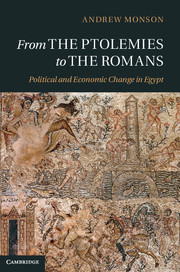
| Summary: | "This book gives a structured account of Egypt's transition from Ptolemaic to Roman rule by identifying key relationships between ecology, land tenure, taxation, administration and politics. It introduces theoretical perspectives from the social sciences and subjects them to empirical scrutiny using data from Greek and Demotic papyri as well as comparative evidence. Although building on recent scholarship, it offers some provocative arguments that challenge prevailing views. For example, patterns of land ownership are linked to population density and are seen as one aspect of continuity between the Ptolemaic and Roman period. Fiscal reform, by contrast, emerges as a significant mechanism of change not only in the agrarian economy but also in the administrative system and the whole social structure. Anyone seeking to understand the impact of Roman rule in the Hellenistic east must consider the well-attested processes in Egypt that this book seeks to explain"-- "This book gives a structured account of Egypt's transition from Ptolemaic to Roman rule by identifying key relationships between ecology, land tenure, taxation, administration, and politics. It introduces theoretical perspectives from the social sciences and subjects them to empirical scrutiny using data from Greek and Demotic papyri as well as comparative evidence. Although building on recent scholarship, it offers some provocative arguments that challenge prevailing views. For example, patterns of land ownership are linked to population density and are seen as one aspect of continuity between the Ptolemaic and Roman period. Fiscal reform, by contrast, emerges as a significant mechanism of change not only in the agrarian economy but also in the administrative system and the whole social structure. Anyone seeking to understand the impact of Roman rule in the Hellenistic east must consider the well-attested processes in Egypt that this book seeks to explain"-- |
|---|---|
| Item Description: | Literaturverz. S. 290 - 329 |
| ISBN: | 9781107014411 1107014417 |